Bite-Sized History Lesson: The Indenture
Whether you mine the ancient world for new RPG adventures or re-fight famous clashes of arms with miniatures, history is a great resource. Sadly, I have this horrible feeling that many younger gamers overlook history as a source of inspiration. Rather than force all gamers under the age of twenty to pass a basic “how to use history in gaming course,” I decided to drop some bite-sized bits of history on my readership and let them use it as they see fit.
“Indentured Servants” is a term familiar to any American student. Landless peasants that signed a contract for free passage to America in return for a fixed period of virtual slavery, usually several years. I understood that the peasants signed a contract, but no one ever discussed what the term “indentured” actually meant. It is a contract, but a very unusual kind of contract. Here is a an image of an actual indenture.
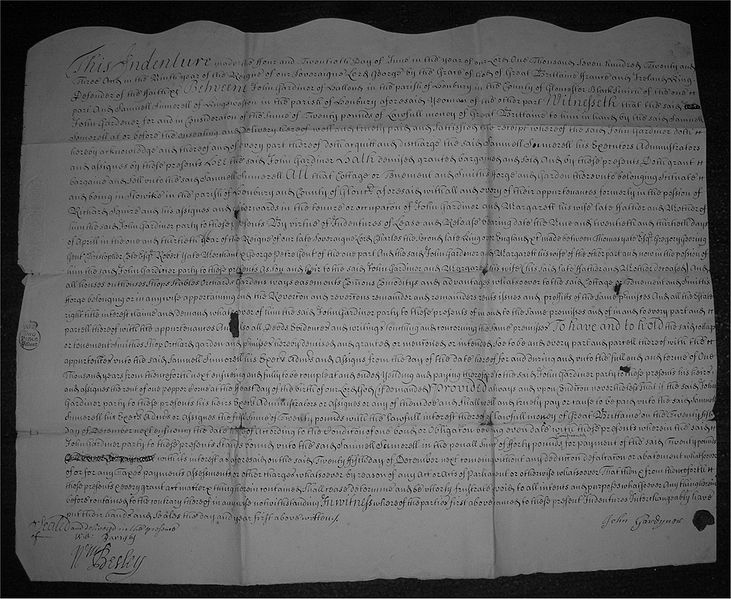
Note the wavy cut at the top of the contract. An indenture is a single piece of paper inscribed with a contract twice on the top and bottom of the page. Both parties sign both sides of the contract and then cut it in half. Each party kept a copy. The irregular cut is a a primitive anti-counterfeiting system that made forgery very difficult. Sometimes in this age of encryption and micro-fibers that there were some quite good anti-counterfeiting technologies that did not rely on advanced technology.
There is also a great shot of a bifurcated, but complete indenture on the Staffordshire, UK government web site. Sorry for not re-posting the image, but there was no license on the site, so I erred on the side of copyright caution.
As to gaming, since the contract is very difficult to forge, protecting/stealing/destroying/finding one-half of an indenture is a great plot hook. It is also a dead easy prop to make for the game table, just print out the document in an appropriate font, copy it twice on a page and cut randomly. I also suggest you check out James Clavell’s excellent Noble House
Much of the plot derives from the hunt for an indenture (a broken coin) that allows the owner to ask a very powerful favor.
The inspiration for this post came from a reference to indentures in Knight: Noble Warrior of England 1200-1600 (General Military)
from OSprey Publishing. This reference only briefly mentions indentures, but I found it a great resource for knights and their equipment for this period.
I hope you find this post useful and I am more than willing to entertain any suggestions for topics in this series.
Trask, The Last Tyromancer


Excellent read. I, also, had not realized that indenture was the style of the contract, not so much the contract itself.